Showing posts with label Great Gardens. Show all posts

10.24.2010

Making an Impression


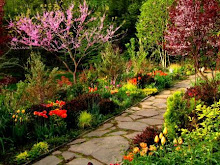
My efforts at garden making, diverse though they may be, tend to rely largely on contrasting the shapes and textures of foliage. Flowers too (and how about those way cool dahlias and Lantana trfolia-a plant I am so hunting for next year.) And since, when it comes to gardening, I'm one of those more-is-better guys, I like dramatic juxtapositions of plants with wildly differing attributes. But on a recent whirl of garden visiting I had to admire an approach almost opposite to mine, an approach that often groups plants by their similarites rather than their differences, an approach that I find ethereal, airy--almost to the point of spectral, and oh-so appealing. Perhaps its allure lies in the likelihood that this is an effect I rarely strive for--with any measure of success--in my own gardens, because the truth is that I have utterly no idea how to go about achieving it, so...I'll just appreciate this vaguely impressionistic effect that to me uderscores a garden's fragility and its transitory beauty.

Take the opening image of Nicotiana mutablis, its pinky white flowers creating a starry firmament above the clouds provided by Euphorbia characias 'Glacier Blue' and Agastache 'Acapulco Salmon and Pink.' The scene looks fragile, almost ghostly, as if it might disappear in a gust of wind. But this vignette at the Ladies' Border at the New York Botanical Garden exhibits real staying power, it will provide that punch for weeks if not months. It's all about the massing of tiny details.

Likewise. on the other side of the NYBG conservatory, I happened upon the Seasonal Walk, this year a Dutch treat courtesy of uber-designers Piet Oudolf and Jacqueline Van der Kloet. Oudolf is known for the creation of evolving, seasoanlly rich plantscapes--many of whicxh are built upon the very frilly, linear shapes which so baffle me whenever I try to group them into combination. But there's no denying the windblown beauty of their creation, and the sheer eye-popping pizzaz of those dahlias nodding amid the plumes of grasses.


Farther afield, at Chanticleer, a similar scene revealed itself. And though horrid lighting prevented capturing a good representation of the tableau, there's no denying the effective use of lots and lots of linear shapes. The grasses, the yucca (is that a rostrata?), and the rest gathered in festive celebration of the airy line. That it works, no doubt. How the conceptual process that pulled it all together evolved, no clue.


Finally, this Chanticleer reverie really got me motivated to try some of these more impressionistic approaches to garden making. Foliage is doing nothing for this flowery fantasia, but the ethereal beauty of these colorful clouds-in primary hues of red, yellow and blue--make this something worth striving toward. And so I shall work next season, once again, to make my own scene that is more gauzy than gaudy, one that relies on likenesses rather than differences, one that is subtle, not shocking. Maybe I'll get lucky.

10.18.2010

Fall Finale at NYBG

With the garden season winding down to winter, I made a trip to the New York Botanic Garden to get a look at their last hurrah in the Irwin Perenial Garden. It's always a great show, from the large scale of the inviting entryway, to the smallest detail.


As always, I was on the lookout for sizzling combos created by juxtaposing bold, broad-leafed thingies against more delicate, airy companions. like, for example, the bigger-than-a-bathmat leaves of this banana rising from a surround of Russian sage (Perovskia atriplicifolia) , coleus, assorted dahlias and more.
 

Color ruled the day in this similarly scaled community of canna, accented by an orange swoon of cigar plant (Cuphea 'David Verity'), with its emberlike tube-shaped flowers all aglow in the overcast. Further firing up the scene were the bigger blooms of a few orange dahlias, smoldering like floating campfires. I know, I know...not everyone likes orange. But I do! Unapologetically. It's more accommodating than red, not as strident as yellow. I find it to be at once both fiery hot and pleasingly mellow.


Back to bold, how about these cool elephant ears (Colocasia esculenta 'Tea Cup'), floating above the filmy firmament of thread leaf bluestar (Amsonia hubrichtii) without benefit of saucers? Oh, and a few red zingers, courtesy of Dahlia royalty 'Bishop of Landaff', make the display ever so much more pleasing.


More thread leaf bluestar never hurts this time of year. While many may plant this standout for the galaxies of starry blue flowers that cover it in late spring, I find it far more valuable in fall, when its fine foliage turns a shimmering gold.


Speaking of gold, if there's a plant that's worth its weight in that precious substance, I'd have to say it's gold Japanese forest grass (Hakonechloa macra 'Aureola'), or any of the similar cultivars that bring so much bling to whatever setting they are placed in. Not only is there that gloooooooooorious color (typo, and it stays), there's the plant's ever-so-appealing lax habit, likened by so many to a waterfall. Long may it flow!
  

One of the most valuable yet simple garden design techniques is repetition. Repetition. You can never go wrong by adding more than one of a kind, and it gets even better when they are spaced out at roughly equal intervals, or if you're more eclectic kind of gardener, at irregular intervals. My feeling is that regular intervals are best because they bring an element of structural formality to a planting, and the more structure you've got, the freer you are to make merry with the rest of the plants. So, ironically, the rigor of regular repeats are ultimately a liberating force. And speaking of repetition, I'm going to have to get back to this garden soon.

9.27.2010

Color It Wild


I'm an equal opportunity garden enthusiast, but I get a touch zealous about what I call handmade gardens-those designed, planted and maintained by the homeowner(s). Handmade gardens are the most personality rich and idiosyncratic of gardens, reflecting, as they do, the undiluted vision of their makers. These are gardens without compromise. And one of my favorite handmade gardens hereabouts is the creation of Les and Monique Anthony, whose Wallingford, CT garden was on tour yesterday as part of the Connecticut Horticultural Society Open Gardens series.


Why do I like it? Well, here's one reason: Les (who's a dab hand with a can of spraypaint) and Monique share a vibrant, playful sense of color. It's apparent in their plantings, which are exceptionally rich in colorful foliage but also in their "stuff," their ornaments, doodads, thingamajiggies, and what not. The chairs, the pots, the tables, on and on it goes. Even something as simple as a metal orb is rethought by virtue of several wildly varied shades of spray paint. I never tire of looking at it. And we'll be back, to see what Les and Monique do with foliage.

7.02.2009

Field Trip to George and Bob's Spring Fling


Back in May, before our rains of biblical proportions began, I went to give a talk in the Hamptons, and while there visited the garden of Bob Luckey and George Biercuk in nearby Wainscott. Again. And it was even better than the first time I saw it. George is a garden designer, and his display of choice selections of all kinds of plants and, most especially, azaleas and rhodies is a show-stopping tour-de-force in spring. And from all accounts it's sweet in October, when legions of tall fuchsia 'Gartenmeister Bonstedt' preside over the garden from one end to the other. I'm looking forward to seeing it then. But in the meantime, let's cut to the chase: pictures. Enjoy 'em.
A network of twisting, turning paths radiates out from the house to weave throughout the garden.

Burgundy Japanese maples--especially the low, mounding cutleaf types- always make stellar backdrops for more delicate plants.


A naturalistic swimming pool lies at the garden's heart.


Love the tawny oranges of this Acer shirasawanum 'Autumn Moon' echo with the orange azalea, rhody, whatever.

6.19.2009

A Late Spring Look At Fergus Garrett's White Flower Farm--Where Anytime Is A Good Time


White Flower Farm hosted their annual eve-of-summer sale today, and, like every other gardener in a 50-mile radius of the place, I was there. After sating my plant lust with a great trove of annuals and a passel of perennials, I decided to swing by the Fergus Garrett border that was the subject of a post a few months ago. So without further ado...here's what it looks like this time of year.


There are no alliums in this shot (at left), but they do play a starring role in many of these combinations. I just wrote about alliums and their value in the late spring garden over at GGW, so it was gratifying to see that these humble garlic relatives get their moment in the sun here at White Flower Farm too.


6.01.2009

Beth Dow's Garden Dreams


Beth Dow photographs all kinds of things, but she creates particularly dreamlike black-and-white images of English and Italian gardens. The limited tonal range of the overall photos, and the spooky aura that seems to emanate from some of the brighter objects makes these gardens seems rooted in the imagination rather than the earth. There's a mystical quality to her work.

Here's what Beth has to say about her photographs, from her website: "These recent photographs were taken in formal English and Italian gardens. The shape and mystery of these places are a natural draw for me as they offer glimpses of the rich traditions of garden making. I am interested in garden history and historical concepts of paradise, and aim for pictures that have a meditative quality to reflect the spiritual urges that inspired the earliest gardens some six thousand years ago."

For more Beth Dow, a slideshow of her discussing her work can be found here.

Hat tip: Dark Roasted Blend

5.27.2009

Art-full Gardens of LongHouse


I've seen gardens that displayed art, and gardens that were artfully planted, but I've never seen anything quite like the LongHouse Reserve, where outdoor art and horticultural high style meet in a seamless embrace. This East Hampton, NY sanctuary aims to "exemplify living with art"--and it does. Wandering its trails and open spaces is a journey of playful discovery, enriched by unusual landforms, contemporary sculpture, and the singular beauty of artfully imagined gardens. At left stand --no, not fallen meteorites--strange, stonelike orbs: "Untitled (Round Forms)" by Grace Knowlton.
Cobalt rods by glass master Dale Chihuly rise from a swirl of grasses.
The arbor re-invented: "Entrance to a Garden" by Dennis Oppenheim. If you actually pass through this intriguing blue structure, you're rewarded with an almost secret seating spot, a welcoming bench perched near a wisteria. And, of course, it's not every day that you see an elephant doing a trunk stand, but maybe that's a good thing. "Elefandret" by Miguel Barcelo.

Below, "Fly's Eye Dome, designed by Buckminster Fuller, is seen through the open "Sea of the Ear-Ring" by Takashi Soga.

Throughout LongHouse, visitors happen upon clusters of primitive-looking pots positioned with dramatic flair.


I especially like these three studies in shape, perched atop a sand dune near the garden's entry. Their somber hues and enigmatic forms are deeply mysterious, and linger in the mind long after leaving the LongHouse Reserve's artful oasis.


4.16.2009

The Greening of Grey Gardens


If you ever saw "Grey Gardens," the Maysles brothers documentary about the spooky, crumbling Long Island manse and the two eccentrics--Big Edie and Little Edie--who inhabited the place, well, you may be surprised at what's become of the old homestead. You'd never recognize the place. Former Washington Post editor Ben Bradlee and his wife Sally Quinn bought the entropy-ridden house and hired artist Victoria Fensterer to redesign and rework the gardens. She's now been at it 23 years, and the results are stunning. The New York Times has a interesting story about the transformation, and a good slide show of pictures from then and now; most of the current pictures are by Robert J. Eckholm.

3.18.2009

Exploring El Explorador


El Explorador has just got to be one of the kookiest, quirkiest gardens anywhere. Where else are you going to see a papyrus allee? Or a grove of bottle trees? Sited darn near the top of a mountain on the edge of beautiful Boquete, Panama, this sprawling hillside garden almost melts into the surrounding forests. It was built as a spiritual refuge of sorts, a place to freshen your outlook on life, and its zany exuberance just about makes that possible. It's peppered with signs (all in Spanish) bearing uplifting quotations and steeped in a playful kind of tranquility, so a feel-good sensibilty just pervades the place.


For a real uplift, try out the hilltop swing, which--thanks to its way high moorings and long ropes--brings you very, very close to the sensation of flight.


They take a very idiosyncratic approach to container gardening, so say the least.


There are loads of wonderful plant world oddities like this cow's udder (Solanum mammosum).


I always stop to smell--no, not the roses--the brugmansias.


Last, but not least, are the inspiring views over the surrounding countryside. Uplifting indeed.