Showing posts with label Design Ideas. Show all posts

10.24.2010

Making an Impression


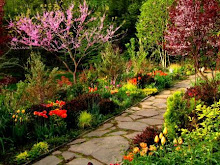
My efforts at garden making, diverse though they may be, tend to rely largely on contrasting the shapes and textures of foliage. Flowers too (and how about those way cool dahlias and Lantana trfolia-a plant I am so hunting for next year.) And since, when it comes to gardening, I'm one of those more-is-better guys, I like dramatic juxtapositions of plants with wildly differing attributes. But on a recent whirl of garden visiting I had to admire an approach almost opposite to mine, an approach that often groups plants by their similarites rather than their differences, an approach that I find ethereal, airy--almost to the point of spectral, and oh-so appealing. Perhaps its allure lies in the likelihood that this is an effect I rarely strive for--with any measure of success--in my own gardens, because the truth is that I have utterly no idea how to go about achieving it, so...I'll just appreciate this vaguely impressionistic effect that to me uderscores a garden's fragility and its transitory beauty.

Take the opening image of Nicotiana mutablis, its pinky white flowers creating a starry firmament above the clouds provided by Euphorbia characias 'Glacier Blue' and Agastache 'Acapulco Salmon and Pink.' The scene looks fragile, almost ghostly, as if it might disappear in a gust of wind. But this vignette at the Ladies' Border at the New York Botanical Garden exhibits real staying power, it will provide that punch for weeks if not months. It's all about the massing of tiny details.

Likewise. on the other side of the NYBG conservatory, I happened upon the Seasonal Walk, this year a Dutch treat courtesy of uber-designers Piet Oudolf and Jacqueline Van der Kloet. Oudolf is known for the creation of evolving, seasoanlly rich plantscapes--many of whicxh are built upon the very frilly, linear shapes which so baffle me whenever I try to group them into combination. But there's no denying the windblown beauty of their creation, and the sheer eye-popping pizzaz of those dahlias nodding amid the plumes of grasses.


Farther afield, at Chanticleer, a similar scene revealed itself. And though horrid lighting prevented capturing a good representation of the tableau, there's no denying the effective use of lots and lots of linear shapes. The grasses, the yucca (is that a rostrata?), and the rest gathered in festive celebration of the airy line. That it works, no doubt. How the conceptual process that pulled it all together evolved, no clue.


Finally, this Chanticleer reverie really got me motivated to try some of these more impressionistic approaches to garden making. Foliage is doing nothing for this flowery fantasia, but the ethereal beauty of these colorful clouds-in primary hues of red, yellow and blue--make this something worth striving toward. And so I shall work next season, once again, to make my own scene that is more gauzy than gaudy, one that relies on likenesses rather than differences, one that is subtle, not shocking. Maybe I'll get lucky.

9.23.2010

Pergolas, and Fine Gardening's Photo Blitz


I worked several years as the managing editor at Fine Gardening magazine, and for many more as a contributing editor, so I wasn't too surprised to get a call from the most-excellently-named associate editor Brandi Spade (left), who'd run across an old photo that included part of one of my pergolas (I've since built several more). Anyway, she needed pictures to accompany a story she was developing about pergola-making, so she and newbie editor Ann Stratton arrived yesterday for a pergola photo blitz.

Below is my best-looking pergola, its entry framed by a few colorful, tropicalesque pots. Any structure adds a synergistic effect to a garden, with enduring bones that create a strong dialog with the more ephemeral plantings that surround them. And any structure looks good all year. I value pergolas, especially, because of the way they soften the transition between indoors and out. Under cover of one, you're sort of betwixt and between, not really inside, not really outside.


Best of all, the inner sanctum of a pergola is what Julie Moir Messervy refers to in her superlative book "The Inward Garden" as an archetypal space, a place that resonates with the magic and mystery of the settings we loved as children exploring our new world. I used to love making forts under the forsythia bushes, so it's probably no accident that a plant-draped, sheltering kind of space is still deeply satisfying to me. I don't know whether Julie would call this a "cave" or a "harbor", or even an "island" (for its feeling of separation from the rest of the world), but what matters is that the cover of the pergola provides me a meaningful retreat.


Because I like pergolas, and the feeling they give me-by inviting me, from the outside, or the sense of security and embrace they provide from within--I've got a few. My veggie garden, though worn out by now, still looks inviting thanks to the pergola attached to my garden shed. Those morning glories-'Heavenly Blue', what else-provide a pleasing echo to the shed's blue hues. By the way, if there is any way to get a truer, long lasting blue into the garden, or anything better than this plant-and-forget-about-it morning glory, please let me know.


Finally, there's my entry way pergola, last to be built, but not least. Slowly but surely it is being covered by climbing hygdrangea, but in the meantime, it frames our doorway and the garden entry. And eases the in/out transition. Like the others, it is of very simple contstruction. I contemplated making it fancy with lots of layers and ornamental cuts, but in the end decided I wanted to stick with the architectural vernacular of the house. Its staunchly colonial, salt-box style would be compromised by anything else. Far as I 'm concenred, the only rule worth having for pergolas is this one: Make your plans, then use wood one size up-6x6 uprights instead of 4x4, 2x8 rafters instead of 2x6, etc. As with so many things in the garden, bigger is almost always better.

9.17.2010

Unearthing My Recent Past

OK, so I've been MFB (missing from blogosphere) for almost a year now. Some sort of explanation might be in order, but it's a long story. Anyhoo, here's some of what I've been up to lately.
Remember this part of the garden? It looks presentable here, but I've never beeen satisfied with it--despite many iterations and years of evolution. A good solution always escaped me.

So we regrouped and called in the earthmover, who came in February to dig the whole place up. incuding the big frozen rootballs of any plants worth saving. This guy was a master at maneuvering his tiny digger and managed to scrape out enough space for a foundation without causing major havoc in the rest of the garden, and soon enough we had Clatter Valley's newest feature: a sunroom.

Lots is going on in there that will be the subject of future posts. I'm growing exotic vines planted in the ground (the floor is gravel, atop richly amended soil), carnivorous plants, a green wall and, of course, it will soon provide winter quarters for some of my favorite tropicals.


Our hope is that this will become our home away from home come winter, where we can dine amid the feel of a tropical splendor. The artiste's sole stipulation is that we have room for a dining table and chairs. otherwise I can run amok in there--and I plan to do just that. Birdboy let loose some anoles (gecko-like lizards) and for a while a finch and parrot were in free-flying residence. Alas, the critters have already escaped to either their reward (the birds) or the great outdoors (the anoles).

Over this sweltering summer, I wrassled 5 tons of stone to create terraces and raised beds that frame our new addition. The place is already starting to settle into the garden at large. Here's a look at some of the pots on the new terrace just outside the sunroom

4.03.2009

I'm In the Magazines


Yankee Magazine ran a story about my spring garden, in a piece that also includes Gordon and Mary Hayward, and Honey Sharp. They miscredited the photos of my garden, which are by me, not Richard Brown. I'm looking forward to the next few weeks, when tulip time rolls around again, and our garden looks like it looked in the picture of our tulip walk published in Yankee.


Clatter Valley is also featured in the current issue of Fine Gardening magazine (May/June 2009, issue #127), with a pared-down story and pictures of my leafy passion--pairings of plants with gold and burgundy foliage, like the glam grouping above. Some of those combos really sizzle in spring, but most of the vignettes pictured are comprised of tender perennials, annuals and tropicals. They headlined my story about these foliar friends "The Color Combo That Always Works." Couldn't have said it better myself.

3.11.2009

A New Way to Go Uphill


These green, grassy steps at The Mount, Edith Wharton's old manse in the Massachusetts Berkshires, are an inspiration. Ever since first seeing them a couple years ago, I've been wondering how I might incorporate a similar feature into my own garden. No success as yet...I'm still wondering how the heck I'd keep the risers trimmed.

12.08.2008

Oh So Succulent


One of my recent garden passions is making little dish gardens of cacti and succulents. They're great for tabletops, since it always bugs me when some centerpiece is so big I can't see the person on the other side of it. And since I use mostly rather small plants --anywhere from an inch to less than foot in height--a tabletop provides a good display spot where it's easier to admire them close-up. These mini mash-ups are very low maintenance: they need virtually no trimming or deadheading, no fertilizing, and they don't care much if you skip watering now and then. Plus they take me back to my garden roots-some of the first plants I grew and loved were cacti and succulents, which I admired for their outlandish sculptural shapes and exotic textures, and for their ironclad constitution-even neglect never seemed to threaten their rugged nature.


Color is another fun component for designing these dish gardens, which look, as Thomas Hobbes once remarked, like little pizzas. While in the old days the palette for these botanic wonders was limited, far as I knew, to greens and silvery greens, it's now possible to find beauteous burgundies, awesome orangey or bronzey hues, and even a few with shadings of chartreuse. I'm always in the lookout for these little treasures, and have found all sorts of great players in unlikely locations such as Home Depot. Good candidates include Kalanchoes, Euphorbias, Echeverrias, Aeoniums, Agaves, Sedums, Aloes, and whatever cacti might catch your eye. I'm looking for everything but flowers. I even collect these guys in the dead of winter, the better to have a grand assortment when spring--and pizza time--comes round again.


Drainage and sun are really the only things these plants demand, so I usually need to drill a few extra holes in the bottom of whatever container I'm using. I especially like using saucers, you know the low dishlike things you'd nomally place under a more traditionally shaped pot. For soil, I use my traditional container mix of 1/3 compost, 1/3 good commercial potting soil, and 1/3 bark mulch, but add to that an equal part of pea gravel. So it's half mix, half gravel. I usually mound the soil on the container so the crowns of the plants are above the edge of the saucer or whatever, so they stay high and dry.


When it's design time, I just play around, moving this plant in, that plant out, until I get a good mix of shapes, textures and colors. Then I just mash them into place-since the pots are usually shallow, there's not a lot of room and I just cram it all together. Hey, cram and jam is my preferred garden style anyway. Low growing sedums--'Angelina' is a good one-- make a great groundcover and are often a welcome addition, then sometimes a mulch of fine gravel or a cool looking stone or two provide a finishing touch. As an alternative, you can go more for a one plant/one pot approach and arrange the pots, as in this scene from Chanticleer

Then I'm free to enjoy my creation all season. Since I use a mix of tender and hardy plants, fall's arrival means I usually bring them indoors and try to overwinter the little gardens. In winter's limited light, some stuff gets leggy or otherwise unappealing. So I might try some cuttings of any real favorites, but the idea is to keep at least some of the plants going so the next season I can tear those planters apart and add their contents to my collection of candidates for a new dish of goodies.

11.18.2008

Wild About Your Garden

Today marks the debut of a new BBC gardening show. Wild About Your Garden picks up an old theme--the garden makeover--but takes it in a new direction. It's garden-design-and-build team creates gardens designed to attract wildlife. Out with the old concrete patio, in with the bird-friendly mixed border. You can catch a preview by clicking on the link above. No clue how much of this show may be watchable via the internet, but you'll find-at the very least-ideas you can use on the website.

11.10.2008

All Fall Down


As Autumn's last leaves drift earthwards, they might inspire new garden compositions. They do for me. At the least, you might think about allowing a scuffle-deep layer of brightly colored leaves to carpet a section of garden or woodland edge for a week or two. But you can also coax more rarefied charms from fallen foliage or flowers. Yesterday I saw this vivid red Japanese maple leaf had tumbled, just so, onto one of the branches of a 'Blue Princess' holly to make a vividly colorful pairing. Such happy accidents are a delight to discover, but you can also encourage them. Really, it's planning in three dimensions--you think about what's in the ground, and about what may, at some time of the year, fall down upon whatever is groundbound, uniting, however briefly, earth and sky. I once saw a spectacular crimson carpet of fallen maple leaves, punctuated by mounds of deep green hellebores; the combination provides exuberant testimony to the beauty of late fall and to the value hellebores play in the garden's shoulder seasons.


Such unions of sky and soil needn't be limited to fall. Think of the potential for making use of the ephemeral carpet created by, say, spent magnolia blooms or the fallen flowers of many spring blooming trees and shrubs. You can even do something in summer, as designer Wesley Rouse has in his Southbury CT garden. (Yes, I know I've already posted this picture, but hey--it's too perfect an illustration to pass up for the point I'm trying to make.) Wesley created a beautiful ground layer of golden Japanese forest grass (Hakonechola macra 'Aurea', and green on green spurflower (Plectranthus forsteri 'Green on Green'). Above them he placed a large princess flower (Tibouchina urvilleana) planted in pot, to give it extra height. The princess flower's blooms are fragile as glass, so any time it rains the blooms shatter and their petals rain down to lend their exquisite color to the complementary gold and chartreuse hues of the grass and spurflower. There's such a Zenlike, ephemeral artistry to this scene, that there ought to be some specific word to describe it. The Japanese, who revere the achingly brief loveliness of cherry blossoms, cherish such moments of transitory beauty. So do I.

10.21.2008

An Oasis of Blue

The color blue has its place in almost any garden. But perhaps in no garden does that hue dominate the way it does in Jardin Majorelle, the amazing blue garden in Marrakech, Morocco, the land of the Blue Men, as the local Tuareg tribesmen are known. I've been to Marrakech a few times, and once even got a role as an extra (a very extra) in Ishtar, one of Hollywoods most high-profile bombs (Dustin Hoffman and Warren Beatty starred). Until my next visit I must settle for this video tour of Jardin Majorelle, a garden that is a major inspiration for my own use of paint as an element of garden design.