10.20.2010

10.18.2010
Fall Finale at NYBG

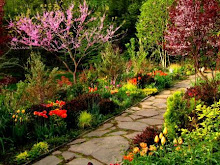
With the garden season winding down to winter, I made a trip to the New York Botanic Garden to get a look at their last hurrah in the Irwin Perenial Garden. It's always a great show, from the large scale of the inviting entryway, to the smallest detail.

As always, I was on the lookout for sizzling combos created by juxtaposing bold, broad-leafed thingies against more delicate, airy companions. like, for example, the bigger-than-a-bathmat leaves of this banana rising from a surround of Russian sage (Perovskia atriplicifolia) , coleus, assorted dahlias and more.

Color ruled the day in this similarly scaled community of canna, accented by an orange swoon of cigar plant (Cuphea 'David Verity'), with its emberlike tube-shaped flowers all aglow in the overcast. Further firing up the scene were the bigger blooms of a few orange dahlias, smoldering like floating campfires. I know, I know...not everyone likes orange. But I do! Unapologetically. It's more accommodating than red, not as strident as yellow. I find it to be at once both fiery hot and pleasingly mellow.

Back to bold, how about these cool elephant ears (Colocasia esculenta 'Tea Cup'), floating above the filmy firmament of thread leaf bluestar (Amsonia hubrichtii) without benefit of saucers? Oh, and a few red zingers, courtesy of Dahlia royalty 'Bishop of Landaff', make the display ever so much more pleasing.

More thread leaf bluestar never hurts this time of year. While many may plant this standout for the galaxies of starry blue flowers that cover it in late spring, I find it far more valuable in fall, when its fine foliage turns a shimmering gold.

Speaking of gold, if there's a plant that's worth its weight in that precious substance, I'd have to say it's gold Japanese forest grass (Hakonechloa macra 'Aureola'), or any of the similar cultivars that bring so much bling to whatever setting they are placed in. Not only is there that gloooooooooorious color (typo, and it stays), there's the plant's ever-so-appealing lax habit, likened by so many to a waterfall. Long may it flow!

One of the most valuable yet simple garden design techniques is repetition. Repetition. You can never go wrong by adding more than one of a kind, and it gets even better when they are spaced out at roughly equal intervals, or if you're more eclectic kind of gardener, at irregular intervals. My feeling is that regular intervals are best because they bring an element of structural formality to a planting, and the more structure you've got, the freer you are to make merry with the rest of the plants. So, ironically, the rigor of regular repeats are ultimately a liberating force. And speaking of repetition, I'm going to have to get back to this garden soon.
10.15.2010
Fab Foliage Friday

 Furcraea are freakin' fantastic! I've proclamied my undying love for all things bromeliaceous or agavaceous in the past, and my ardor shows no sign of abating. Here's why: These plants have a supremely sculptural quality, for my money, one of the best shapes in the whole plant kingdom. Its sturdy, meaty leaves thrust purposefully from the ground. Like broadswords, they parry the elements, slashing at wind, and cutting through the rain. The plant's resolute nature gives it an elegant, classical quality.
As a collector of plant oddities, I am always on the lookout for plants that are like little works of art, and consider my garden (at least parts of it), to be a living gallery of chlorophyllic, sculpturous shapes and textures-furcraeas fit right in. They also appeal because they are spineless-which is not to say they have no presence--on the contrary! What they don't have are spines, or, colloquially, prickers, stickers, thorns or whatever you want to call the lethal protrusions that make handling agaves a dicey proposition. Put a furcraea in a pot (or better yet, an urn), put the pot anywhere there's enough room, and presto-you have just improved the neighborhood. Sadly these things aren't hardy in my USDA Hardiness Zone 6 garden, but they seem content lolling away the winter in my basement, illumined by a few florescent lights. I photographed these specimens at the New York Botanic Garden, so not certain of the species or cultivar name but probably Furcraea gigantea 'Variegata'.
10.11.2010
New Guinea's Newbies

 It's always good news to hear about the discovery of new species, rather than the disappearance of those already known. Happening upon unknown life forms reveals magic and mystery in the world we inhabit, and offers proof positive that one need not journey to the bottom of a deep ocean trench or distant star system to encounter terra incognita.
New Guinea continues to provide new finds for the most special of treasure hunter-those seeking life hitherto unknown to science. The latest discoveries come from the Muller mountains of Papua New Guinea and the Nakanai mountains of nearby New Britain, off New Guinea's coast.Some 200 new species of plant and animal were observed by Conservation International researchers.Their finds included the freaky looking tube nose fruit bat (previously seen but still little known, though scientists have verified that he is not related to Yoda) and the spooky pink-eyed katydid (both photographed by Piotr Naskrecki). The cute tiny frog, a member of the genus Litoria, also hails from the Muller mountains and was lensed by Stephen Richards.

Discussing the new finds, Richards, the team's leader, told AP, "They tell us how little we still know about the world. There's a lot of concern, quite rightly, about biodiversity loss and climate change and the impacts on biodiversity and what biodiversity means to us. ... Then we do projects like this and we discover, 'Hey - we don't even know what biodiversity is out there.'"
10.08.2010
Fab Foliage Friday

So many coleus, so little time. As a longtime leaf lover, I'm always flying my freaky foliage flag high--which means I can always make room for a new coleus or or two--but I also reserve a spot-or five-for returning favorites. Topping the old-but-good list of late is 'Sky Fire' a boldly hued coleus that grows to about 18 inches wide and high. Its deep, dark burgundy, shimmering chartreuse and yippie-yai-yay yellows make it invaluable in the hot color combinations on which I thrive.
10.07.2010
Bee Happy!

Melting ice caps, dying coral reefs, droughts, heat waves, famine--amid the tidal wave of environmental disaster, today gives us a reason to be thankful. Researchers have discovered the cause of Colony Collapse Disorder, the mysterious affliction that is decimating North America's honeybees and thus threatening production of almost every fruit and vegetable we eat. No cure yet, but understanding the cause is step one, Read all about it in the NYT.
10.06.2010
Mindo Lindo

 Our ongoing search for magical places that fuse our passions for amazing landscapes, abundant plant life and exotic birds led us to Mindo, Ecuador, a tiny town clinging to the cloud-forested western slopes of the Andes. This teeny little place, not much more than a wide spot in the dirt road, was worth every bit of effort it took to get us there. Even the fruit stands were a work of art.

Mindo is all about the river, which thunders down from the mountains to bisect this lush forested valley. The river, with its water-polished stones, and at its side the sleepy, lost-to-the-world ambiance of Mindo itself, made me think of the town as a real-life Macondo, the mythical, mystical village at the center of Gabriel Garcia Marquez's masterpiece "One Hundred Years of Solitude."

 There are few bridges in this part of the world so to cross the flow, we had to hop aboard a tarabita--a sort of hand-hauled cable car with seating for one-to reach our absurdly oversized cabin. Birdboy loved this kind of commute. I did too.
The river's soothing voice was the constant soundtrack as we hiked local dirt roads and muddy paths, on the lookout for plants (about which more in a future post), birds and other exotica-like giant spiders dangling from huge webs. One night we went hiking in the pitch-black jungle to see nocturnal life-a panoply of even stranger insects and such than we'd seen during the day.

 Wherever we walked, outageously oversized tropical foliage was everywhere. It was so tactile, begging to be touched. And it came in handy as umbrellas for the Artiste and Birdboy, and, in the case of this dried out cecropia leaf, a hat.

 Wherever we walked, outageously oversized tropical foliage was everywhere. It was so tactile, begging to be touched. And it came in handy as umbrellas for the Artiste and Birdboy, and, in the case of this dried out cecropia leaf, a hat.
Our favorite outing took us along a an amazing dirt road (torturous for anyone, like me, with a fear of heights) clinging to the spine of a mountain range just east of Mindo.

 We bumped along for a couple hours befiore dismounting and plunging into steep and deep jungle, where our most excellent guide Fernando led us to a research station in the middle of absolutely nowhere. There we had a tasty surpise-a breakfast of all kinds of fruits, eggs, bread and hot black coffee (all very welcome, since we'd set out well before dawn). We followed paths through valleys darkened by layer after layer after layer of vegetation. Butterflies flitted about, and birdcall--more than 350 species can be found hereabouts--provided a musical soundtrack. Finally we emerged at this spectacular waterfall.

 We bumped along for a couple hours befiore dismounting and plunging into steep and deep jungle, where our most excellent guide Fernando led us to a research station in the middle of absolutely nowhere. There we had a tasty surpise-a breakfast of all kinds of fruits, eggs, bread and hot black coffee (all very welcome, since we'd set out well before dawn). We followed paths through valleys darkened by layer after layer after layer of vegetation. Butterflies flitted about, and birdcall--more than 350 species can be found hereabouts--provided a musical soundtrack. Finally we emerged at this spectacular waterfall.

The sheer height of the waterfall, coupled with the massive leaves of the elephant ear in the foreground seemed to complete the notion that we were some kind of Gullivers, adrift in Brobdingnag, where EVERYTHING is bigger than real life. In the end, I had just one question about Mindo: When can we go back?
10.05.2010
10.01.2010
Fab Foliage Friday

I know I've crowed about elephant ears before, but this is a new one! Colocasia esculenta 'Elena' is a winner, with nicely ruffled chartreuse ears providing snappy contrast for the purplish veins that run through them. This appears to be one of those easy-to-please, foolproof plants that look good just about anywhere. As yet, I haven't tried it everywhere, just among these coleus, cordylines, canna and cacti, so I know for certain it works well with any plants beginning with the letter "C." Next year, I'm going to be trying some "D" plants. That would be a lot easier if I lived further south-the Plant Delights write-up says this baby is hardy clear to Zone 7b, at least. Here in Zone 6, I'm going to try overwinter this in my cool dark basement.
9.30.2010
In the Galapagos: Change We Can Believe In

 Just about everybody knows the strange Pacific Ocean islands of the Galapagos were the jumping off point for Charles Darwin's theory of evolution.Those isolated bits of land seemingly adrift in the vastness of the Pacific offer a glimspe into the crucible of life and, literally, a textbook study of the concept of natural selection. The island birds, esp the finches (such as this cactus finch on Genovesa, aka Tower Island) and the mockingbirds, have evolved distinct species on different islands.

So, when we think of evolution, we tend to think of the animal kingdom, but the Galapagos also reveal a slower kind of evolution, the gradual transformation of barren volcanic rock to rich rainforest. Look how it all starts in these islands, which, like Hawaii, are the result of a hotspot, a leaky hole in the Earth's crust far below the surface of the sea. Lava oozes out of the hole and over the millennia forms massive mountains The tips gradually emerge from the sea to become islands, the Galapagos Islands.

 Soon, the lava cools. Colonies of aptly named lava cactus appear. This rugged pioneer plant is one of the very first to grab a toehold on the forbidding, sun-baked lava flats. Gradually it spreads its roots into the lava, cracking it apart, and beginning the torturously long, slow process of turning stone into soil.

As eons pass, sea life washes up onto the lava shelfs to die and decompose, adding nutrients to the soil.

As the lava slowly breaks down to a sandy substance, the little, silvery whiskbrooms of tiquilia arrive.

Color arrives as soil is enriched by the decay of pioneer plants, animal matter and the like. The era of grasses dawns, along with thorny shrublets and mats of sesuvium, a succulent that turns fiery colors in the dry season. Land iguanas love to prowl through this stuff.


These amazing creatures look utterly prehistoric and exhibit amazing diversity, lumbering past in a paintbox set of hues comprised of yellows, reds, and oranges.

Trees rise. The Galapagos are parched during the dry season, when trees such as palo santo, the holy stick, drop their leaves. It leafs out and blooms around Christmas, with the return of the rains, Palo santo is related to frankincense, and its sap contains an aromatic resin burned in mainland Ecuador's churches as incense.


Along with the trees, a variety of cacti begin to reach for the sky.

 Among them are various prickly pears, which here rise to exceptional heights. Their towering stature is due to another freakish characteristic of life forms that have evolved in island isolation over many thousands of years, gigantism. Think of Komodo dragons, the famed Galapagos tortoise (similarly sized tortoises can also be found in the Aldabra islands, an isolated archipelago in the Indian Ocean), or, heck, even King Kong. In the Galapagos there's a bit of a chicken-and-the-egg question that goes with gigantism--did the prickly pear get big to keep its fruits from being consumed by giant tortoises, or did tortoises grow big to reach more prickly pear fruit? Maybe it's an exotic example of symbiotic co-evolution.

Life begets life. At some point, the diversity of plant and animal species increases and, as if through some synergistic magic, increases yet again. The older islands are actually quite green and diverse, while newer bits of land are still baked lava crust supporting a paucity of species. For most of the birds for which the Galapagos are so famed, and for many of the other critters, the islands aren't much more than a place to nest and take a rest--all their food comes from the surrounding seas. At any rate some day, as here in the highlands of Santa Cruz, the islands support a rich, almost rainforest abundance of life. Thus, a new Eden is born.

9.29.2010
Beauteous Bulbines


Guess what's odd about Bulbine frutescens. It's got no bulb. Nor does it have a rhizome, corm or tuber. But aside from its ill-chosen name, there's plenty to like about this stellar South African native known to locals as snake flower, cat's tail, or burn jelly plant (yes, it has some medicinal value). Bulbine is actually a succulent, but I know few that flower as freely as this one. I grow bulbine in a pot, where its hummock of rather finely textured grassy foliage looks tidy and well mannered early on. Later in the season, narrow wands rise skyward to erupt with a clown hat of tightly nestled buds which, soon enough, yield delicate orange flowers. When a plant produces 10-15 or more spires at a time, the effect is glorious. There's one drawback: the whole thing is kind of dinky, with the wands reaching, on a good day, maybe 18-24 inches and each flower smaller than a thumbnail. But pretty! And so wonderfully complex. Carefee as any succulent, and easy to overwinter indoors in cool temps and bright light.
9.28.2010
Man-Eating Plants!!!

 OK, have I got your attention? Good. Now take your mouse, tickle it, and head straight over to Dark Roasted Blend for a superlative photo collection of carnivorous plants in all their resplendent glory. These pix are just great, and the whole carnivorous clan is represented, from pitcher plants to sundews and venus flytraps. The only one missing and--come to think of it--the only actual man-eater is Audrey, the vexing vegetation from the Little Shop of Horrors. Though none of these are hungry for Homo sapiens, some are big enough to eat a rat. Yum!
Dog Soup

9.27.2010
Color It Wild

 I'm an equal opportunity garden enthusiast, but I get a touch zealous about what I call handmade gardens-those designed, planted and maintained by the homeowner(s). Handmade gardens are the most personality rich and idiosyncratic of gardens, reflecting, as they do, the undiluted vision of their makers. These are gardens without compromise. And one of my favorite handmade gardens hereabouts is the creation of Les and Monique Anthony, whose Wallingford, CT garden was on tour yesterday as part of the Connecticut Horticultural Society Open Gardens series.

 Why do I like it? Well, here's one reason: Les (who's a dab hand with a can of spraypaint) and Monique share a vibrant, playful sense of color. It's apparent in their plantings, which are exceptionally rich in colorful foliage but also in their "stuff," their ornaments, doodads, thingamajiggies, and what not. The chairs, the pots, the tables, on and on it goes. Even something as simple as a metal orb is rethought by virtue of several wildly varied shades of spray paint. I never tire of looking at it. And we'll be back, to see what Les and Monique do with foliage.

Subscribe to:
Posts (Atom)