6.26.2009

Fab Foliage Friday


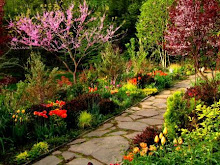
Oh yeah! Gold feverfew (Tanacetum parthenium 'Aureum') glows like there's no tomorrow. Old herbalists believed, and still do, that feverfew is a good remedy for fever and for headaches. Well, if your headache comes from wondering how to brighten up the garden, this variety will have you feeling better in no time. For me (here in Zone 6a), gold feverfew is a short-lived perennial but it does self sow. Unwanted seedlings are easy to pluck, but better still is a plan to give the plants a shearing before--or when--their little, yellow-centered white daisylike blooms appear. As I've mentioned, I'm not fond of white except in specific circumstances, and where I like gold feverfew is rarely included in those instances. So I shear my gold feverfew down by about half or even a bit more and soon bright new growth comes up to keep it vigorous looking for the remainder of the season. I do let a few flower, so I can collect the seed--which I just scatter--to establish new colonies.

6.25.2009

Clatter Valley In The News


Among the things that have been occupying my time of late are some stories I've done for our local paper, the Hartford Courant. I forgot to post about them. I did one on sheds, and another on using veggies in ornamental gardens.

Pots In The News


Good container gardening story by New York Times garden writer Anne Raver in today's paper. It's largely about succulents, but she also talks to Bob Hyland, one of the owners of Loomis Creek, a worth-the-detour nursery in Hudson NY. Hyland, along with Margaret Roach, also participated in a container challenge of sorts at the Berkshire Botanical Gardens. Their efforts will be on display this summer. I plan to go up and see them a bit later; I want to wait for the plantings to ripen and fill out a bit. Look for a future post on the topic. Thanks to photog Stewart Cairns for the NYT pix.

6.21.2009

Poppy Perfection


It's here! The arrival in my garden of the stunning poppy Lauren's Grape (Papaver somniferum 'Lauren's Grape') is one of my favorite moments in the whole garden season. Blooming as it does about the first day of summer, this Kool-Aid-colored poppy signals the start of the celebrated (by me anyway) season and the beginning of hot weather, when the tropicals, tender perennials and annuals really take off and, soon after, give my garden its late-season zing. Plus, what's not to like about this deep dark color, appearing atop a stem clothed in crinkly blue green foliage and studded with nodding buds that salute the sky when flower time comes? It even self sows, so once you've got it, you've got it forever after.

When this distinctively hued flower first popped up in papaverphile Lauren Springer's garden, she recognized it as the apex of annual poppiedom, ripped out all its lesser rivals and spent something like seven years to develop a seed strain that would come true. It was worth every minute. Some years back, she gave a bag of seeds and I've appreciated this plant ever since. Thanks, Lauren!

6.19.2009

A Late Spring Look At Fergus Garrett's White Flower Farm--Where Anytime Is A Good Time


White Flower Farm hosted their annual eve-of-summer sale today, and, like every other gardener in a 50-mile radius of the place, I was there. After sating my plant lust with a great trove of annuals and a passel of perennials, I decided to swing by the Fergus Garrett border that was the subject of a post a few months ago. So without further ado...here's what it looks like this time of year.


There are no alliums in this shot (at left), but they do play a starring role in many of these combinations. I just wrote about alliums and their value in the late spring garden over at GGW, so it was gratifying to see that these humble garlic relatives get their moment in the sun here at White Flower Farm too.


Fab Foliage Friday


Is it a leaf? A flower? Or what? I'm calling the lovely veined pitchers of Sarracenia 'Judith Hindle' a leaf, because its flowers look a lot more like, well, flowers. Whatever you call them, this plant is one handsome piece of chlorophyll. I grow it in a little bog container garden, which I overwinter in a cold frame since the plant would not be likely hardy here in USDA Zone 6. It's worth the trouble.

6.16.2009

Got Slugs?

This wet, wet weather we're having brings not only April, May, and June flowers, it brings slugs. Tons of 'em. I thought I had it bad, but after seeing this video from South Africa I'm not complaining about the slugs in my yard ever again.

6.13.2009

Brussels Loves Begonias


Three million begonias is a lot of begonias-enough to make this 300 square yard floral carpet, which brightens downtown Brussels. These are cut flowers, laid down right on top of the cobblestones. One hot, hot sunny day and the whole thing must be toast. Talk about ephemeral art. Belgians have been recreating these vast medieval carpet patterns with begonia bloms for almost 40 years as part of their ongoing efforts to promote interest in and awareness of the flower. Certainly gets my attention.


Hat tip: Martha Cheshire and First Post

6.12.2009

Fab Foliage Friday: Field Trip


TGIFFF! To celebrate, we're off on a field trip to the gardens of John Marchacos in Berlin, CT. I often proselytize about building gardens from the leaves out, about creating textures and contrasts with foliage. John-who's an epimedium enthusiast (guess who E. 'Marchacos Sprite' is named for), and lover of woodland ephemerals-lives it. He gardens in the shade, so the effects he creates are far different from the combinations I pursue in my sunnier spot. But let's not muck things up with a bunch of verbiage. Instead, just look at the pix.
This is one sweet knot garden.

I've always liked this walkway.

But, lest you thin it's ALL about leaves, John has a few flowers too. He's one of the few Deutzia connoisseurs I know (not that they're bad, it's just that few gardeners seem to know more than one or two varieties). Here's a shot of 'Pink-A-Boo' in bloom. Silly name, super plant.


6.05.2009

Fab Foliage Friday


The perfectly pinnate leaves of wild senna (Cassia marilandica aka Senna marilandica) are looking just great right now, but that's no surprise--these herbaceous perennials look good all season. I can't understand why this worthy native of the midwest and southeast isn't a more common presence in gardens. It's got distinctive foliage, a nice shrubby size-to 4 or 5 feet high and nearly as wide across-that makes it a good background plant, and it's basically care free (though it may need staking in shade). Plus it good for tough clay soils. And it's even easy from seed. What more could you want? Oh yes, flowers-it's got them too. Towers of yellow flowers top the plant in summer, and then give way to dangling blackish seed pods several inches long.

6.04.2009

Peony Time


Peonies are the belle of the ball. Any ball. Without doubt they are the most overdressed, most blowsy, most extravagant flower in the garden. They are an ode to botanical excess. I guess that's why you gotta love 'em. No other plant in my garden contributes as little as the peony for 11 and 1/2 months of the year, but during their brief moment in the sun, they rule. Totally.

All my peonies are anonymous. No idea who they are. As luck would have it, some years back the Artiste's brother purchased a farm, which had been, back in the day, a peony, iris and daylily farm. As my brother-in-law planned to turn the former flower fields into veggie gardens and hay-filled meadows, we got out there lickety split with shovels and filled my pick-up truck several times over with whatever goodies we could glom. As for the flowers, it was all sight unseen--we had no idea what we were getting. But hey, free peonies? How bad could that be? Still, it was a lot of work-the fields had been abandoned years earlier, so we had to carefully weed each clump of unidentified stuff we dug.


But nameless doesn't mean graceless. As it turned out we had dug loads of old-fashioned single peonies, which, for me have a charm that harkens back to an earlier era. They also have a wonderfully delicate fragrance. Due to their limited season of interest (Okay, early spring's emerging stalks are cool too, and the ruddy colors look great with the right tulips), I've relegated most of our peonies to a peony ghetto, which looks--and smells--splendiferous for about 14 days--if, God willing, it don't rain and the creek don't rise. We're entering that two-week span right about now, and doggone if those old-fashioned peonies don't look better every year. So, breathe deep. It's swoon time here at Clatter Valley.


One last thing...What's a peony without ants? The buds and even the flowers are usually crawling with them. The little critters just go nuts over the sweet, nectary secretions of the plant's globelike buds. They just can't keep away from those oh-so-ephemeral flowers. And neither can I.


6.03.2009

My New BFF


Jatropha (Jatropha integerrima 'Compacta') is my new Best Friend Forever. Wow! What color! I had to position this near the French doors, where I can look out anytime to see its bright red beacon blazing away like a lighthouse. I was lucky enough to recieve a standard last fall, from someone who didn't want to overwinter the thing, and it survived the dark (no light at all) recesses of my cool basement, and was flowering within a couple weeks of bringing it back into the heat and light this spring. I woke the jatropha up from its winter slumber by placing it in my little pop-up greenhouse.

Ever since, the thing has been going great guns, with beautiful screaming scarlet flowers erupting from bright red buds. Okay, the flowers are small, but that color! I never tire of looking at it. And the leaves! They're cool too! They come in several shapes--like sassafras leaves--and as the new ones appear they have a beauteous bronzy sheen. I'm smitten. Gee, looks like the start of yet another tropical love affair.

6.02.2009

Tulips From The Treetops


It's tulip time...again. But now, it's the tulip tree (Liriodendron tulipifera)--one of the lords of the eastern woodland forests--that rules. These massive trees often protrude above the forest canopy; they're among the tallest trees in the woods. And, in my opinion, one of the most beautiful. When I was a kid, I loved gazing up at their long, arrow-straight trunks. I still do. We're fortunate enough to have several, and this morning I walked outside to discover a perfect flower had fallen. Usually we just get beat-up bits and pieces on the ground, so finding a whole blossom is a treat. I'm always enchanted by their lime-chartreuse and orangey yellow egg-yolk colors.

6.01.2009

Beth Dow's Garden Dreams


Beth Dow photographs all kinds of things, but she creates particularly dreamlike black-and-white images of English and Italian gardens. The limited tonal range of the overall photos, and the spooky aura that seems to emanate from some of the brighter objects makes these gardens seems rooted in the imagination rather than the earth. There's a mystical quality to her work.

Here's what Beth has to say about her photographs, from her website: "These recent photographs were taken in formal English and Italian gardens. The shape and mystery of these places are a natural draw for me as they offer glimpses of the rich traditions of garden making. I am interested in garden history and historical concepts of paradise, and aim for pictures that have a meditative quality to reflect the spiritual urges that inspired the earliest gardens some six thousand years ago."

For more Beth Dow, a slideshow of her discussing her work can be found here.

Hat tip: Dark Roasted Blend

5.29.2009

Fab Foliage Friday


What time is it? It's Sem, Sem, Sem, Sem, Sem, Sem, Sem, Sem, Semmertime! I am bowled over by the way-cool foliage of Ural false spirea 'Sem' (Sorbaria sorbifolia 'Sem'). Absolutely, positively had to have it the instant I laid eyes on it. The ferny foliage is utterly distinctive, so it promises to combine well with just about anything, and as if that weren't enough, this small shrub's leaves are utterly colorific, with hues of yellow, orange, bronze and red. Wowsa! So what if it suckers like crazy? I can deal with that. Love it with tulips (top), plus, the emerging foliage of early spring is killer (at left) and so are the first sets of unspooled leaves (below). 'Sem' and I are going to have lots of fun together.

5.27.2009

Art-full Gardens of LongHouse


I've seen gardens that displayed art, and gardens that were artfully planted, but I've never seen anything quite like the LongHouse Reserve, where outdoor art and horticultural high style meet in a seamless embrace. This East Hampton, NY sanctuary aims to "exemplify living with art"--and it does. Wandering its trails and open spaces is a journey of playful discovery, enriched by unusual landforms, contemporary sculpture, and the singular beauty of artfully imagined gardens. At left stand --no, not fallen meteorites--strange, stonelike orbs: "Untitled (Round Forms)" by Grace Knowlton.
Cobalt rods by glass master Dale Chihuly rise from a swirl of grasses.
The arbor re-invented: "Entrance to a Garden" by Dennis Oppenheim. If you actually pass through this intriguing blue structure, you're rewarded with an almost secret seating spot, a welcoming bench perched near a wisteria. And, of course, it's not every day that you see an elephant doing a trunk stand, but maybe that's a good thing. "Elefandret" by Miguel Barcelo.

Below, "Fly's Eye Dome, designed by Buckminster Fuller, is seen through the open "Sea of the Ear-Ring" by Takashi Soga.

Throughout LongHouse, visitors happen upon clusters of primitive-looking pots positioned with dramatic flair.


I especially like these three studies in shape, perched atop a sand dune near the garden's entry. Their somber hues and enigmatic forms are deeply mysterious, and linger in the mind long after leaving the LongHouse Reserve's artful oasis.


Lady Slippers!


We live in what is primarily hemlock forest, and if you've ever walked through a wood like that you might have been impressed by something--the almost complete lack of any understory growth. But our hemlocks are a bit mixed and enough light reaches the earth to allow the growth of several kinds of terrestrial orchids, even pink lady slippers (Cypripedium acaule). We're lucky to have such rare treasures. The stars must be aligned just right, as these dainty pouchlike plants require very specific growing conditions. But we've been worried of late--the hemlocks are dying off as a result of wooly adelgid, and the changing forest is playing havoc with what little life is on the forest floor. Our biggest swaths of pinks lady slippers have declined amazingly in the last few years. In one spot we went from more than 20 a couple years ago to a lonely trio now. So, it was a fine surprise yesterday, when I happened on a brand new stand of lady slippers growing in the shade of several magnolias I planted at the forest edge. Life goes on.

5.22.2009

Fab Foliage Friday


I've been remiss in posting of late. Too many writing deadlines! And at a time of year I rarely undertake much in the way of writing assignments. So between that and the demands of the season, well, I seem stretched pretty thin. But enough excuses. TGIFFF!!!

Can't quite put my finger on what it is that appeals to me quite so much about Chinese Neillia (Neillia sinsensis). Maybe it's the Japanese maplelike foliage...I'm a sucker for anything like that. Could be it's more like a ninebark (Physocarpus opulifolius 'Diablo')...I like them too. Or perhaps it's the coppery, burgundy-tinged hue of the new leaves...ditto. Or maybe even the way the leaves ride this small shrub's delicately arching branches. Who wouldn't like that? Really, I guess it's all those things, on this neat new plant given me by my friend Lydia Wallis, who's hosting me this weekend while I give a talk at the Horticultural Alliance of the Hamptons in NY. Thanks again Lydia!

You know, maybe there's an additional reason this plant is looking so fine right now, and though FFF is not about flowers, since you may not be familiar with Neillia I thought I'd include a pic of its blooms, which have just burst open from tight, bright, coral-colored buds. All in all, Neillia is a refined, delicate looking plant and I'm delighted it now has a home in my garden.

5.15.2009

Fab Foliage Friday


In spring, a man's fancy turns to...bananas? Mine does anyway. Soon as the weather warms up, I think about exhuming my bananas from their winter quarters in the cool dark basement and bringing them up into the light, so they can start growing like crazy. It doesn't take much--some heat, light and water, and they're off to the races.

And what's not to like about the burgundy splotched foliage of Musa sumatrana 'Zebrina'? As Birdboylikes to say, "I don't like it, I LOVE it!" Especially with tropical smoke bush (Euphorbia cotinifolia).

5.08.2009

Fab Foliage Friday


It's ti time! Ti plants, of the genus Cordyline, are most commonly grown has houseplants. Which is fine, but gee, they look great in the garden too. Once the weather warms up I usually make a trip down to Lowe's or Home Depot, grab a few cheap ti plants and use them to plug any holes in the border. They look even better when you enliven the color combos with some long-flowering tender perennials such as this duranta (Duranta 'Homerus Depotus').